Brain Entrainment
Before examining this question, it is important to understand the phenomenon collectively known as brain entrainment.
Brain entrainment—also referred to as brainwave synchronization or neural entrainment—is a natural biological process in which the brain’s electrical activity gradually aligns with the rhythm of an external, repeating stimulus such as sound, light, or vibration.
At the core of entrainment lies the Frequency Following Response (FFR). When the brain is exposed to a steady rhythmic stimulus—auditory, visual, tactile, or electromagnetic—it naturally begins to mirror that rhythm in its own neural activity. This occurs through large-scale neural synchronization within the cerebral cortex, where groups of neurons fire in alignment with the frequency and timing of the external signal.
Entrainment is largely involuntary and autonomic. Humans instinctively synchronize to rhythm—much like unconsciously tapping a foot to a drumbeat or becoming absorbed in repetitive sounds. This synchronization can be induced through multiple sensory pathways:
- Auditory stimulation (binaural beats, isochronic tones, monaural beats)
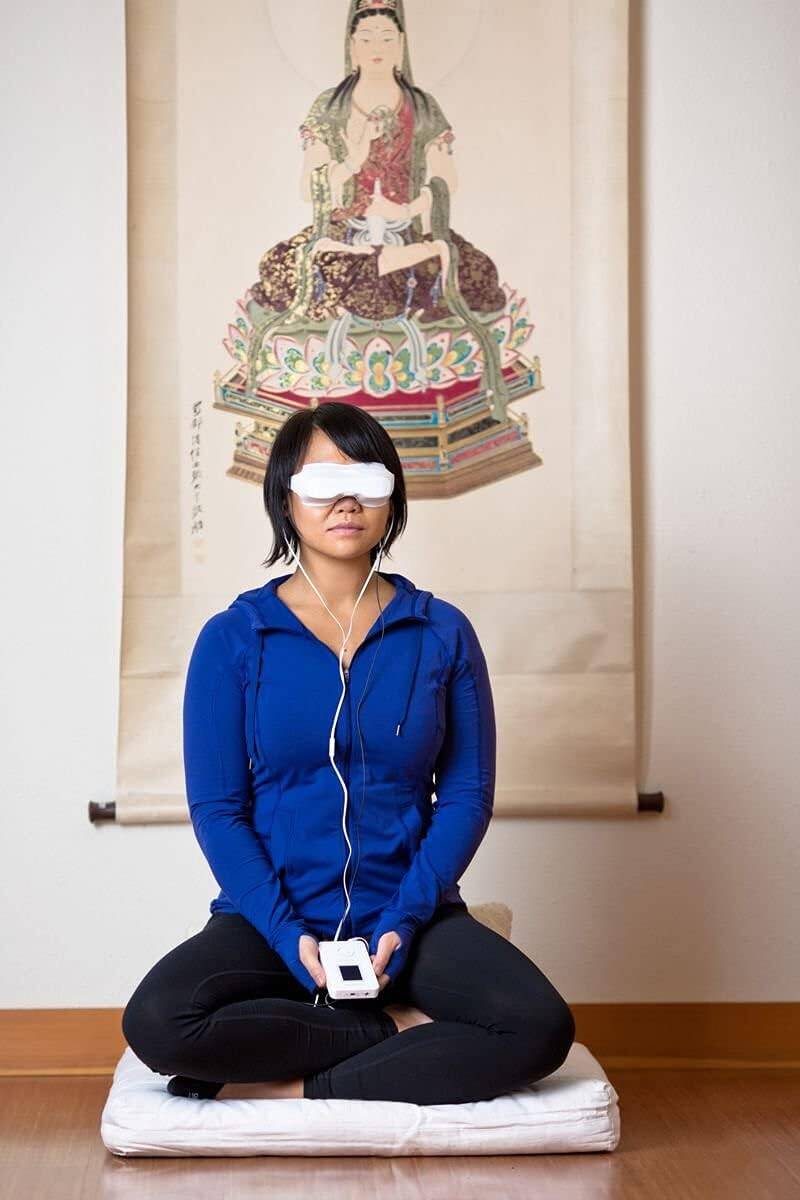
- Visual or photic stimulation (flickering lights via LED glasses or headsets)
- Tactile or haptic stimulation (vibrations felt through the body)
- Electromagnetic methods (such as pulsed electromagnetic fields or transcranial stimulation)
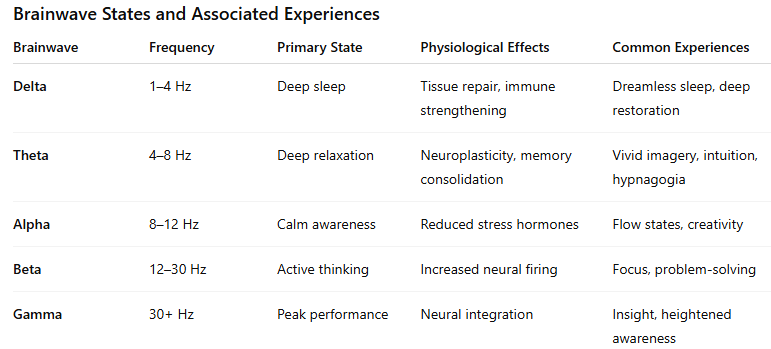
The purpose of brain entrainment is to gently guide the brain into specific frequency ranges associated with distinct mental, emotional, and physiological states.

Historical Foundations of Brain Entrainment
Brain entrainment is far from a modern invention. Binaural beats were first described in 1839 by Prussian physicist Heinrich Wilhelm Dove, though they remained largely a scientific curiosity for more than a century.
In the late 1950s, Robert Monroe, a radio broadcasting executive, began experimenting with sleep learning and altered states of consciousness. During these experiments, Monroe used himself as a test subject and unexpectedly began experiencing spontaneous out-of-body experiences (OBEs). This led to extensive research into the effects of sound on consciousness and ultimately to the founding of The Monroe Institute in 1971. Monroe later patented Hemi-Sync® technology in 1975—a multi-layered audio approach designed to synchronize both hemispheres of the brain.
Around the same time, parallel scientific research was taking place. In 1973, biophysicist Dr. Gerald Oster published the landmark paper “Auditory Beats in the Brain,” providing empirical validation of binaural beats. Oster’s work focused primarily on medical and neurological diagnostics, whereas Monroe’s focus was on consciousness exploration. Importantly, Oster used simple, isolated binaural tones, while Hemi-Sync combined multiple layers—pink noise, music, and verbal guidance—to create a more immersive and directive experience.
How Binaural Beats Work
When listening to binaural beats, two slightly different frequencies are delivered separately to each ear through stereo headphones—for example, 400 Hz to the left ear and 410 Hz to the right. These signals converge in the superior olivary complex of the brainstem, the first structure that integrates auditory input from both ears.
Rather than perceiving two tones, the brain interprets the difference between them as a rhythmic pulse—in this case, 10 Hz. Through the Frequency Following Response, neural activity may begin to synchronize with this perceived beat.
For binaural beats to work effectively:
- Stereo headphones are essential
- Carrier tones should be below ~1,000 Hz
- The frequency difference should typically be under 30–35 Hz
Without headphones, the tones mix in the air and produce monaural beats, a different phenomenon.
Isochronic Tones
In 1981, Dr. Arturo Manns of the Universidad de los Andes in Chile documented isochronic tones, demonstrating a stronger entrainment response than binaural beats.
Unlike binaural beats, isochronic tones use a single tone that turns on and off at precise intervals. This creates sharply defined pulses that do not require headphones and can be played through speakers. Because the rhythmic stimulus is explicit rather than perceptual, isochronic tones often generate a more robust cortical response.
The Blending Method
Combining binaural beats and isochronic tones creates a synergistic effect. Isochronic tones quickly drive the brain toward a target frequency, while binaural beats help stabilize and deepen the state over time.
This layered approach engages multiple neural pathways—perceptual and physical—often enhanced further with ambient music or noise to soften the sharper pulses. For individuals less responsive to one method alone, blending can significantly improve effectiveness.
Brain Entrainment as a Fast Track?
A landmark 2004 study led by Dr. Richard Davidson at the University of Wisconsin–Madison examined eight Tibetan Buddhist monks with 10,000–50,000 hours of meditation experience. Compared to novice controls, the monks exhibited gamma activity up to 30 times stronger during compassion meditation, along with unprecedented long-range gamma synchrony—coordinated firing across distant brain regions.
Remarkably, elevated gamma activity persisted even at rest, suggesting long-term structural brain changes.
Brain entrainment technologies attempt to approximate aspects of these states—particularly gamma activity around 40 Hz—through external stimulation. While entrainment does not replicate the amplitude or durability of a master meditator’s brain activity, research and anecdotal reports indicate it can reliably induce milder versions of these states in untrained individuals.
Benefits commonly reported include enhanced focus, emotional regulation, reduced stress, improved learning, and brief states of clarity or insight. These effects are typically state-dependent, occurring during use rather than persisting long-term.
Nevertheless, entrainment may serve as a powerful on-ramp—supporting meditation practice and accelerating access to deeper states that traditionally require years of training.
Technology as a Tool, Not a Shortcut
There is no true shortcut. However, based on personal experience, I would argue that brain entrainment offers a meaningful advantage for newcomers. Not all of us began meditative practice in childhood. For those starting later in life, these tools can provide a significant head start.
My very first meditation was a Monroe-guided session. The experience was surreal and opened the door to many profound states that might have taken years to access through traditional methods alone. After training at the Monroe Institute, I learned that these states are indeed achievable without technology—but if you need to dig a trench, a backhoe is more efficient than a spoon. Both work; one simply gets you there faster.
Additional Methods for Facilitating Expanded States
I currently use a Healthy Wave PEMF mat set to 4 Hz to support deeper meditation. While PEMF is not true entrainment, it appears to facilitate quicker access to meditative depth—possibly aided by the mat’s heat and crystal composition. Isolating the exact contributing factor is difficult.
🔗 https://HealthyWaveMat.com/index?referrer=CNWR_197051769193196
Photic stimulation devices, such as the MindPlace Kasina, pair visual entrainment with audio and have shown promising results. I currently have one on order and will be reviewing it in future articles. Shop here: MINDPLACE KASINA
I am also exploring pairing entrainment audio with sensory deprivation float tanks. I’ve sourced both waterproof earbuds and bone-conduction headphones for experimentation. Float tanks alone are powerful; combined with frequencies, the effects may be amplified significantly.
Finally, I plan to integrate vibroacoustic mats—both independently and alongside photic stimulation—to explore full-spectrum multisensory entrainment.
Get your Woojer Mat SHOP HERE and use stackable discount code INFINITE10 to save on any current promo!
Stay tuned for after-action reports.

Add comment
Comments