If you have ever tried to sit still for meditation and spent the first twenty minutes negotiating with a stiff back, cold feet, or a brain that will not settle, a full-body wellness mat starts to make sense. I have been using the HealthyLine TAJ PEMF mat as part of my practice for two years now, and it has become less of a gadget and more of a ritual: lie down, set the heat so I stay comfortable, drop the PEMF into theta, put on binaural beats, and let the session do the work.
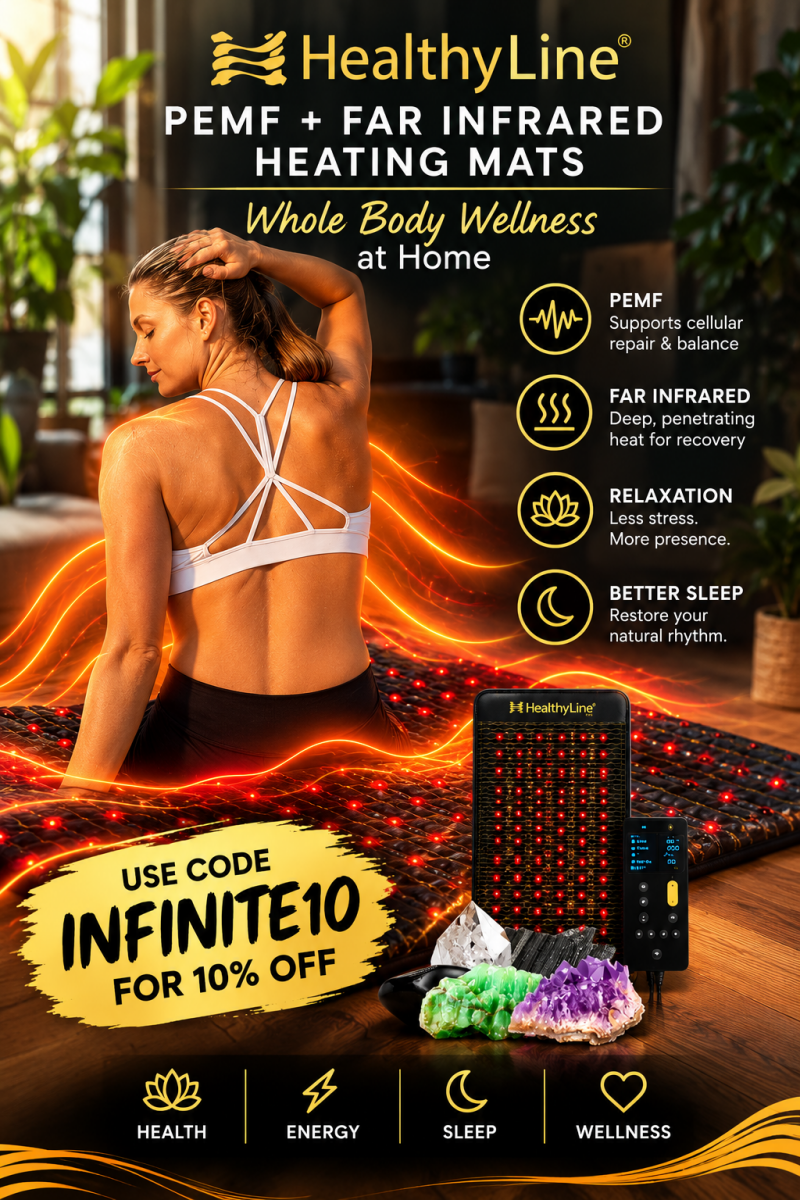
The TAJ is HealthyLine’s best-selling multi-therapy line. It stacks five modalities in one mat: PEMF, far-infrared heat, 660 nm red/photon light, negative ions, and hot gemstone therapy with amethyst, jade, and tourmaline. You can shop the series here: HealthyLine TAJ PEMF mats. Use code infinite10 at checkout for 10% off.
This is not a medical device review, and it is not a promise that a mat will “hack” enlightenment. It is an honest look at how the therapies feel together, why I run mine at about 98°F and 4 Hz, and what actually comes in the box.
What the TAJ actually is
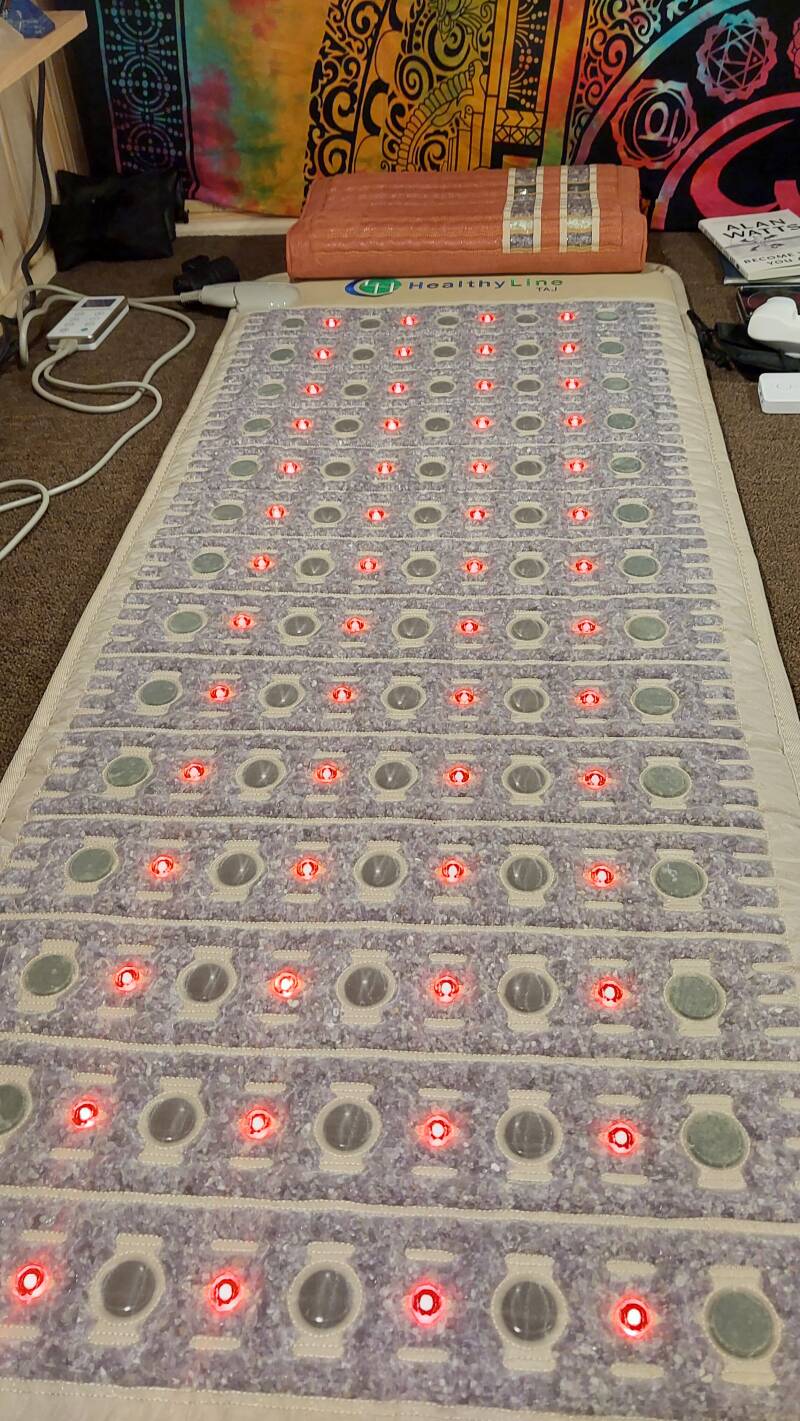
HealthyLine’s TAJ series is a firm, multi-layer mat (up to around 21 functional layers, depending on the size) with crushed amethyst plus rounded jade and tourmaline stones under the surface. Heat warms the stones. The stones radiate far-infrared and help generate negative ions. A separate PEMF coil system pulses a low-intensity magnetic field you can set from 1–30 Hz. A layer of red LEDs (typically 660 nm) can be switched on independently.
On the full-body sizes you are looking at something like a 60" x 24" or 72" x 24" mat, roughly an inch thick, and heavy enough that you will pick a home spot for it rather than toss it in a weekender bag. Smaller pads and a chair-size version exist if you only want targeted use. Heat goes up to about 158°F / 70°C. For meditation I never go anywhere near that.
Controller-wise, the TAJ is manual, not “press program 3 and walk away.” That is a feature for meditation. Heat, PEMF frequency, and photon light are independent. Timer and auto shut-off are there so you can drop in without watching a clock.
My meditation settings: 98°F and 4 Hz
Two numbers matter more than the marketing sheet.
Heat at 98°F.
The manual ranges treat roughly 95–105°F as the overnight / long-session zone. That is the point. I am not trying to sauna. I am trying to stay just warm enough that my body stops sending “adjust the blanket” messages. At 98°F the gemstones feel like a mild, even warmth rather than a hot-stone table. I can stay down for a full sit without sweating or fidgeting. If I want a more detox-style session later in the day, I raise the temperature and shorten the time. For meditation, comfort wins.
Give the mat 15–20 minutes to preheat. The stones hold heat, so the surface keeps climbing after you first lie down if you skip this.
PEMF at 4 Hz.
Theta brainwaves sit around 4–8 Hz and show up in deep meditation, drowsiness, and that floating “I am here but not running the to-do list” state. Delta is slower (deep sleep). Alpha is a bit faster (relaxed alertness). The TAJ lets you pick any integer from 1–30 Hz, so 4 Hz is a clean theta-edge setting.
A few important distinctions so this stays honest:
- PEMF is a pulsed magnetic field through the body. Binaural beats are an auditory illusion created when each ear hears a slightly different tone. They are not the same mechanism.
- “Brainwave entrainment” usually means a rhythmic stimulus (sound, flicker, or sometimes electromagnetic pulses) that the nervous system can lock onto. Research is mixed and depends on the method, frequency, volume, and the person.
- What I actually do is stack them. The mat holds the body still and warm. 4 Hz PEMF is the physical pulse. Headphones with theta binaural beats or isochronic tones give the ears a matching tempo. Breath slows. Attention has fewer places to leak.
I treat 4 Hz as a condition for practice, not a guarantee I will drop into theta on command. Some days it is deep. Some days it is just a better nap-adjacent rest than the couch. That is still useful.
If you want a more “grounded earth” feel instead of deep-theta, HealthyLine often points people at ~7.8 Hz (Schumann-style). For wind-down before sleep I would go lower, toward 1–3 Hz Delta. For a daytime reset, mid-range frequencies feel more alert. The point of a manual controller is that you can match the session to the sit.
The five therapies, and how they show up in a session
1. PEMF (pulsed electromagnetic field)
TAJ PEMF is a sine-wave field, about 2 Gauss at the top end, 1–30 Hz, controlled separately from heat. That intensity is in the gentle consumer-mat range, not a clinic-grade high-Gauss system. HealthyLine and similar brands talk about cellular energy, circulation, recovery, and sleep. The evidence base for PEMF is strongest in specific medical contexts (certain bone-healing protocols, some pain and inflammation research) and thinner when the claim becomes “wellness in general.”
What I notice subjectively: a very subtle pulse rather than a massage-gun thump. At 4 Hz it is easy to forget it is on until I turn it off and the session feels flatter. I do not leave high frequencies running during meditation. Faster settings feel more “on” and are better saved for a morning or post-workout pass.
Note: PEMF on this line typically cycles (commonly described as a period on, then a longer rest). Do not expect a continuous 40-minute magnetic beat.
2. Far-infrared heat
Far-infrared here is in the roughly 5–14 μm band, produced as the wiring warms the gemstone layer. Unlike a heating pad that mostly warms the skin, FIR is sold as deeper, gentler radiant heat. Practically, it is what makes the mat feel like a warm stone bed instead of an electric blanket.
Wellness uses people buy it for: muscle ease, the “I can finally unclench” effect, temporary relief of stiffness, and that sauna-adjacent sweat if you crank the temperature and add the foil blanket. For meditation I keep it at body-adjacent warmth so the heat supports stillness instead of becoming the main event.
Hydrate before and after warmer sessions. Start low if you are heat-sensitive.
3. Red light / photon therapy (660 nm)
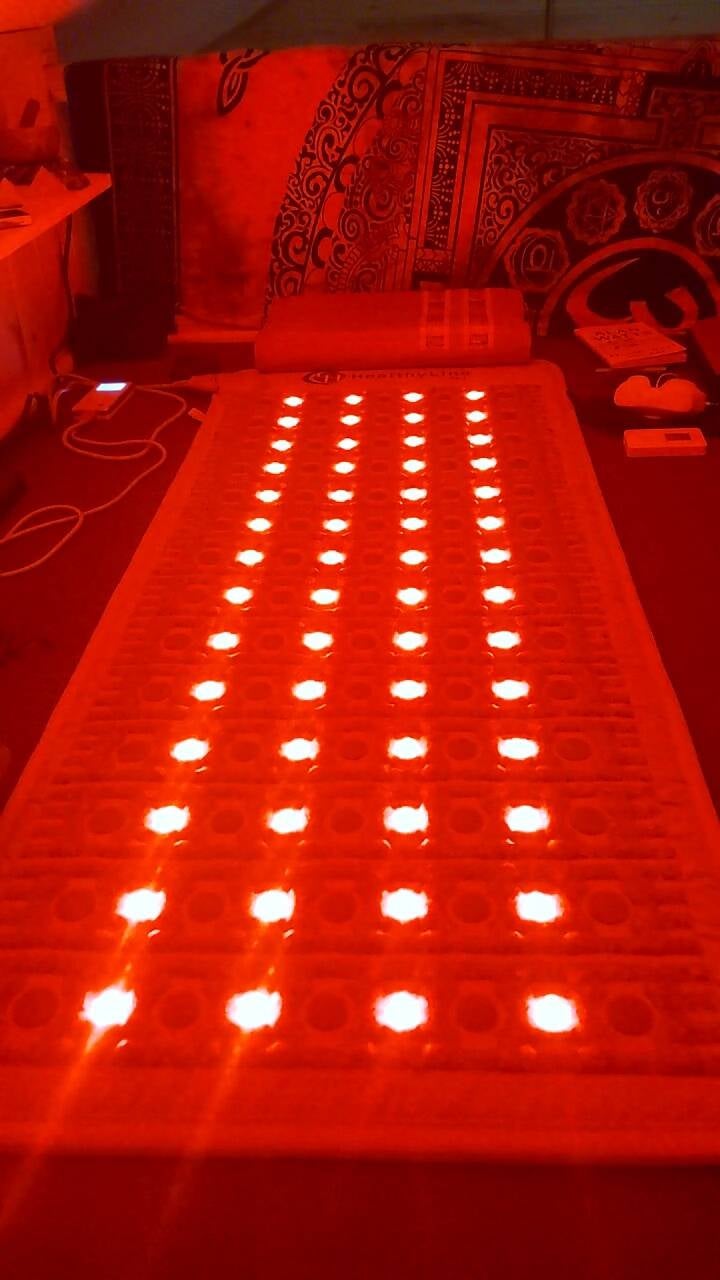
The TAJ uses visible red LEDs around 660 nm, with the LED count scaled to mat size (on the order of 50–60 on the larger mats). Red light in this band is the same neighborhood used in many consumer photobiomodulation panels. Lab and clinical work on red/NIR light is interesting for skin, certain wound and inflammation contexts, and cellular energy pathways. A mat with LEDs under your back is not the same as a dedicated high-irradiance face panel, and fabric or a thick cover will cut the dose.
I turn the lights on when I want the session to feel more “daytime repair” and sometimes off when I want a darker, more inward sit. They do not add heat the way FIR does.
4. Negative ions
Heated tourmaline and related stones are used to generate negative ions (HealthyLine cites on the order of 1,500+ per cubic centimeter on TAJ models). This is the same idea as ionizers and “forest air” marketing: mood, perceived air freshness, a calmer room. The research on indoor negative-ion generators and health is mixed; some people love the feeling, some notice nothing.
On the mat it is not a separate switch. It rides along with heat and the stones. I treat it as atmosphere, not a measurable protocol.
5. Crystal / gemstone (hot stone) therapy
The TAJ mix is specific:
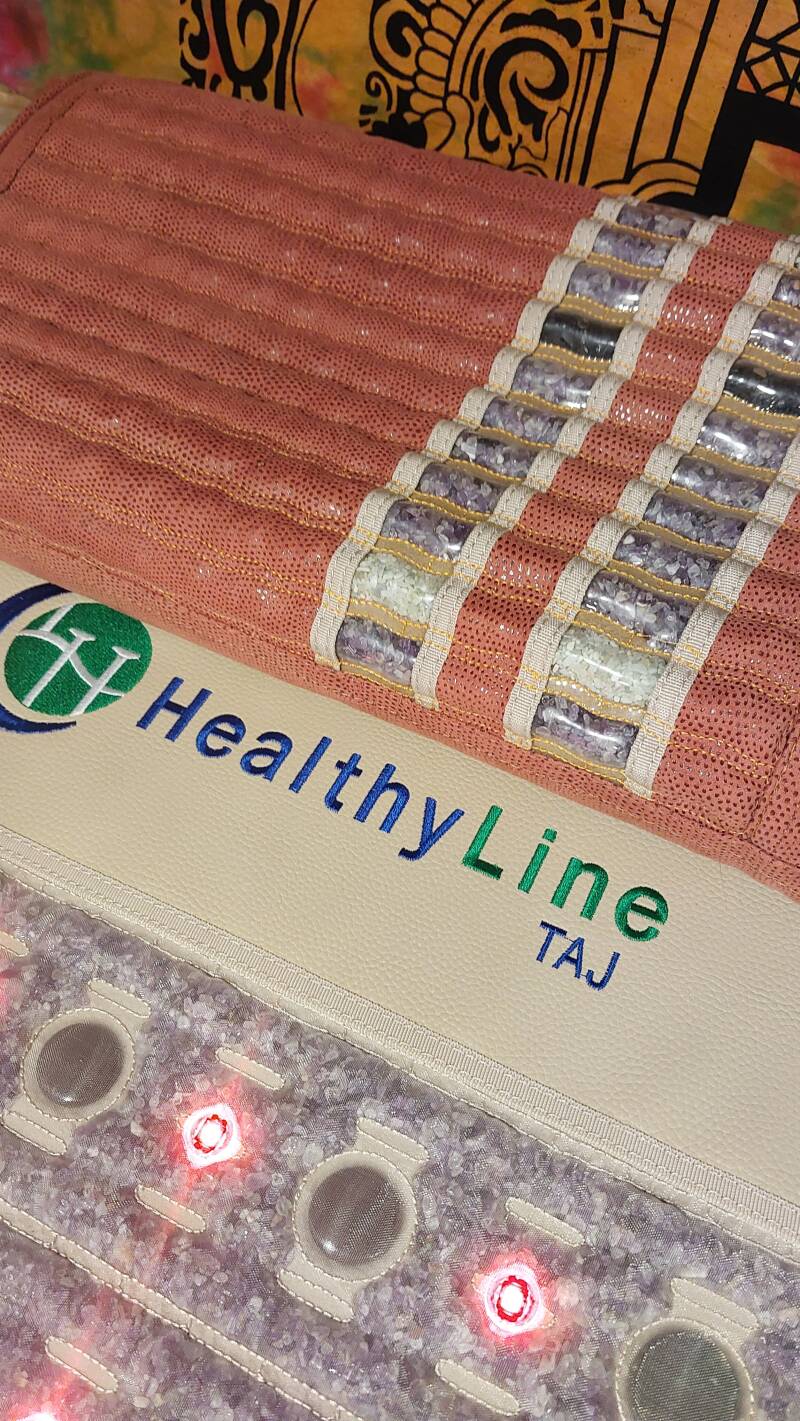
- Amethyst (crushed layer): traditionally associated with calm and “mental quiet.” On the mat it is also a FIR-friendly fill that makes the surface a bit more even.
- Jade (rounded stones): classic hot-stone material; holds heat, slight acupressure.
- Tourmaline (ceramic/rounded): the workhorse for heat plus ion talk, and the “grounding” stone in the marketing.
You will feel the stones. This is not a memory-foam mattress topper. It is a firm, pebbled surface. That pressure is part of the point for some people and a deal-breaker if you wanted plush. The cotton padded cover takes the edge off without killing the heat.
I do not need the stones to be “vibrationally programmed” for the session to work. Warm mineral mass plus gentle point pressure is enough of a reason to include them.
Pairing the mat with binaural beats
This is the part that made the TAJ stick in my routine.
A typical sit:
- Preheat the mat to 98°F with the cotton cover on.
- Set PEMF to 4 Hz.
- Photon on or off depending on whether I want light in the room.
- Lie down, foil blanket over the legs or torso if the room is cool.
- Headphones: a theta binaural track (carrier tones with a 4–6 Hz difference between ears) or a simple isochronic pulse. Low volume. No lyrics.
- Timer for 20–40 minutes. Eyes closed. Breath in the belly.
Why the stack helps, without overselling it:
- Heat reduces the “scan for discomfort” loop.
- A steady 4 Hz pulse and a 4 Hz beat give the mind an external metronome. Entrainment is not magic; it is closer to why a slow drum or ocean recording makes sitting easier than silence on a loud-brain day.
- You are horizontal, so posture fights less than a zafu on a cold floor.
- The session has a start and an end. That matters more than people admit.
If binaural beats feel irritating or give you a headache, skip them. The mat still works as warm stillness plus PEMF. Isochronic tones or a plain low-frequency ambient bed are fine substitutes. This is support for practice, not a replacement for it.
Wellness uses beyond meditation
People buy these mats for more than sitting. The honest list of “this is why the five therapies are in one slab”:
- Recovery and stiffness. Warm FIR + stones is the most immediately obvious effect. Post-workout or after a long desk day, a mid-heat session feels like a poor man’s spa table.
- Winding down at night. Low heat, low Hz. I would not sleep all night on the firm full-body TAJ unless you like a hard surface; HealthyLine’s bed/topper versions exist for that.
- A defined recovery block. Timer plus auto shut-off makes “I will lie here and not check my phone” easier to keep.
- Targeted use. The 20" pad or chair mat is the move for shoulders, low back, or under the feet while you work.
What I would not claim: that this replaces a clinician, heals disease, or that gemstones have been proven to do what crystal shops say they do. Use it as a comfort-and-regulation tool. If you have a pacemaker, implanted electronics, are pregnant, or have a condition where heat or EM fields are a concern, talk to a professional first. HealthyLine lists the usual cautions for a reason.
Accessories: what actually shows up in the box
This is one of the better “you can use it the day it arrives” kits in this category. A typical TAJ shipment includes:
- LED controller — heat, timer, PEMF frequency, photon on/off. Manual, simple, no app required.
- PEMF visualizer — a small magnetic indicator so you can see that the field is pulsing. Oddly satisfying the first time, useful when you wonder if you set it right.
- Cotton padded cover — the one I use for meditation. Softer on skin, still lets heat through.
- Waterproof cover — sweat, pets, spills. Use this when the session is warmer or you do not want the cotton layer against the stones.
- Sauna foil / mylar blanket — reflects FIR back toward the body. Excellent for a cocoon-style rest or when the room is chilly. I use it over the lower body so my face stays cool.
- Carrying case — necessary because the full-size mats are heavy and awkward. Good for storage and dust more than true travel.
- Warranty card and user guide
You do not need to buy a separate “starter bundle” to have a complete setup. Extra covers are worth it later if you use the mat daily.
Practical comfort tips: put a thin yoga towel on the cotton cover if you run hot. Keep water nearby. Do not fold the mat like a blanket; these are built to stay flat.
Build, feel, and the tradeoffs
Pros
- Five therapies with independent heat, PEMF, and light.
- Frequency range actually includes theta, delta-adjacent, and Schumann-style settings.
- Low-heat mode is usable for long sits, not only 20-minute sweat sessions.
- Accessories are complete.
- Multiple sizes, including pads if a 20-plus-pound mat is too much.
- Typical HealthyLine protection: about a 90-day return window and a 5-year limited warranty. HSA/FSA eligibility is often advertised.
Cons
- Firm. The stones are a feature and a limitation.
- Heavy. This lives on the floor or a table, not in a suitcase (unless you buy a mini).
- No preset programs on the TAJ controller. You will set 4 Hz and 98°F yourself every time until it is muscle memory.
- PEMF is modest intensity (~2 Gauss). If you want a high-powered clinic mat, this is not that.
- Red light dose through a cover is not equivalent to a dedicated panel.
That mix is why the TAJ sells. It is a home wellness station, not a research instrument.
Who it is for
Worth it if you already meditate or want a dedicated “lie down and change state” corner, and you like the idea of heat + pulse + light in one place.
Skip or size down if you need something plush, portable, or strictly evidence-maximal for a single therapy (buy a good PEMF device or a good red-light panel or a good heating pad if you only care about one of those).
How to save: code infinite10
HealthyLine pricing on TAJ full-body mats typically lands in the high-hundreds to around a thousand-plus before sales, depending on size. Smaller pads cost less and are a sane way to test the feel.
Use code infinite10 for 10% off at healthyline.com/6310.
That code is the simplest way to knock a noticeable amount off a mat that already includes the controller, covers, foil blanket, and case. Check current site pricing and stock when you order; sizes go in and out, and there are wrap and bed-topper versions if you want overnight use instead of a floor sit.
Bottom line
The HealthyLine TAJ works for me because I can keep it at human temperature and a theta-range pulse, then add binaural beats on top. The gemstones and FIR make the body willing to stay put. The red light and ions are extras I will take, not the reason I lie down. 98°F keeps the session comfortable. 4 Hz gives the sit a tempo.
If you want a multi-therapy mat for meditation and recovery rather than a single-purpose medical device, the TAJ is a coherent setup — and infinite10 makes the jump easier.
This review reflects personal use and publicly listed product specs. It is not medical advice. Follow the manufacturer’s safety guidance.
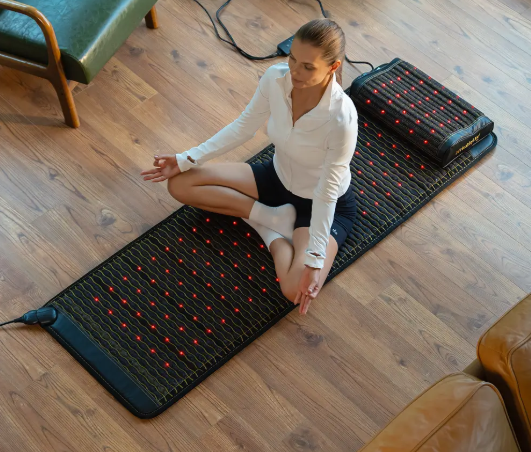
HealthyLine does not make one TAJ mat — it makes a whole size ladder, which is part of why the line works for different rooms and bodies. The 20" × 20" pad (~$349) is the travel / targeted option for a low back, belly, or feet. The 32" × 20" (~$499) covers more of the torso on a couch or chair. The TAJ Chair 40" × 18" (~$599) sits behind you at a desk or in a recliner. Full-body starts at the 60" × 24" (~$849), the better pick if you are around 5'5" or shorter; the bestselling 72" × 24" (~$1,049) is the standard lie-down mat; and the Pro Plus 74" × 28" (~$1,499) is the wider, massage-table size. There are also TAJ Bed toppers in queen, king, and split halves if you want overnight use instead of a floor session. Same five therapies across the TAJ mats — PEMF, far infrared, 660 nm red light, negative ions, and amethyst / jade / tourmaline — just scaled to the footprint.
Outside TAJ, HealthyLine’s catalog is basically “pick your intensity and flexibility.” TAO is the same firm PEMF-and-heat idea without the red LEDs, so it costs less. SOFT drops PEMF and photon and stays bendy, which is the move if you mainly want warm gemstones. Platinum steps the PEMF up for people who want more field strength and waveform options. Jet is the newer performance line, with a wider frequency range, stronger PEMF, more LEDs, and extra stones (obsidian and quartz on top of the usual mix). They also sell 360° wrap sets for around-the-body sessions, sauna blankets, gemstone pillows, extra covers and controllers, and even magnetic bracelets. Browse the current TAJ sizes and the rest of the shop at healthyline.com/6310, and use infinite10 for 10% off
Add comment
Comments